Economic dependence and debt
The MetamorphosisEconomic dependence and debt is not merely background pressure in the Samsa family apartment; it is the mechanism that organizes Gregor Samsa’s working life, his sense of filial duty, and the family’s response to his transformation. Gregor remains at his job because his income supports his parents and because he has undertaken to repay the debt owed to his employer. Once his labor disappears, the household must rediscover its own earning capacity, and the change gradually turns Gregor from provider into burden, then from family member into a problem to be removed.
Gregor as Debtor and Provider
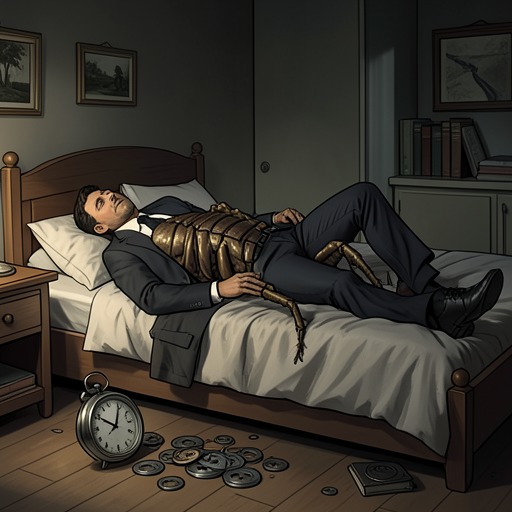
Gregor Samsa’s first response to his transformation is economic rather than metaphysical. Although he has become physically incapable of carrying out ordinary human tasks, he worries about the train he must catch, the samples he must pack, the anger of his employer, and the consequences of reporting sick. His work as a travelling salesman requires constant travel, difficult train connections, irregular food, and contact with strangers, yet he continues because his parents depend on the income. He calculates that he must work another five or six years to gather enough money to pay off his parents’ debt to his employer; only then does he imagine making the decisive change of leaving the job.
Gregor’s imagined resignation reveals the unequal exchange at the center of his family life. He resents the boss’s authority, especially the way the boss sits above subordinates and speaks down to them, but he cannot act on that resentment while his parents remain financially exposed. His wages have therefore purchased more than household necessities: they have purchased the family’s temporary security at the cost of his freedom, time, and bodily endurance. The debt transforms filial devotion into an economic timetable, postponing independence until a future that the transformation makes impossible.
The family’s earlier business failure explains why Gregor has accepted this burden. Five years before, his father’s business collapsed, reducing the household to despair. Gregor responded by working with unusual intensity, rising from junior salesman to travelling representative and placing his earnings directly on the table at home. The family received the money with gratitude, and Gregor was glad to provide it, but the warmth of their earlier relationship did not grow in proportion to his contribution. His financial success instead established a durable expectation that he would bear the costs of the whole family.
Hidden Reserves and the Limits of Security
After Gregor is confined to his room, his father discloses that the family has not been left entirely without resources. He has preserved some money from the failed business in a small cash box, and the savings have accumulated interest. The family has also kept part of Gregor’s monthly earnings rather than spending everything he brought home. Gregor is pleased by this unexpected thrift because it means that his past labor has produced a reserve rather than vanishing completely into daily consumption.
The reserve is nevertheless too small to support the household indefinitely. It could maintain the family for perhaps one or two years, but it is emergency money, not a permanent income. The distinction is crucial: the family possesses assets, yet it remains dependent on current labor. Gregor’s transformation therefore does not create economic insecurity from nothing; it exposes the precariousness that his wages had temporarily concealed. His father is healthy but old and lacks confidence after five years without work. His mother suffers from asthma and struggles even to move around the home. Grete Samsa is only seventeen and has previously lived a protected life centered on clothing, sleep, modest pleasures, and the violin. The loss of Gregor’s income forces every member of the household to be measured against the question of earning power.
Gregor experiences this redistribution of responsibility as shame and regret. When the family discusses the need to earn money, he lets go of the door and throws himself onto the leather sofa, becoming overheated by the knowledge that his parents and sister may now have to work. His previous role as provider has become a standard against which the others must suddenly perform, while his own inability to contribute makes him feel responsible for their exhaustion even though he can no longer control the cause of it.
The Family Re-enters the Labor Market
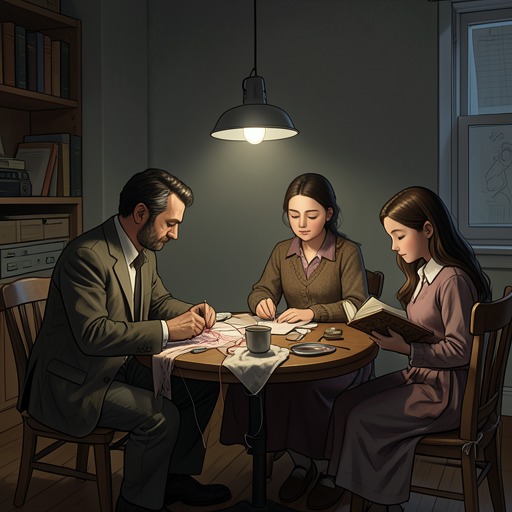
The household gradually replaces Gregor’s lost income through a division of labor. His father returns to employment and later appears in a uniform that he refuses to remove even at home, as though he must remain permanently ready to obey a superior. His mother takes on sewing for strangers in addition to the domestic work of the apartment. Grete finds a sales job and studies shorthand and French in the evenings in the hope of obtaining a better position. These activities show the family becoming economically active again, but they also reveal the cost of that recovery: rest, conversation, and attention to Gregor are reduced to what is absolutely necessary.
The household’s material adjustments are concrete and cumulative. The maid is dismissed and replaced by a charwoman who performs the heaviest work. The family sells several pieces of jewelry, despite the attachment that both mother and daughter have had to wearing them at social occasions. They remain in an apartment that is too large for their altered circumstances because relocation seems difficult while Gregor is still there, but their inability to move also reflects despair and the burden of managing an exceptional household. The family therefore survives through intensified labor, reduced consumption, the sale of possessions, and the preservation of whatever housing stability remains.
The new work pattern changes the emotional balance of the family. Before the transformation, Gregor’s income allowed the others to remain outside the labor market, and their dependence helped define his place as the responsible son. Afterward, each person becomes a worker, while Gregor becomes the only member without an economic function. The family’s renewed prospects at the end of the story are consequently inseparable from his exclusion: the household’s future improves when its former provider is no longer part of its daily calculations.
From Care to Economic Disposal
At first, the family’s care for Gregor is shaped by the hope that his condition may still be understood as illness and managed through patience. His parents remain outside his room for the first fourteen days, while Grete takes responsibility for tidying, observing what he has eaten, and reporting whether there has been any improvement. Gregor’s injured body is still recognized as belonging to a family member, and the apple lodged in his flesh remains a visible reminder that he cannot simply be treated as an enemy.
That limited recognition weakens as care becomes another unpaid task within an overworked household. Grete hurriedly pushes food into Gregor’s room before work and removes it later, often untouched. The cleaning becomes faster and less thorough; dirt remains on the walls and dust gathers in the room. When Mrs. Samsa cleans the room herself, the dampness makes Gregor ill, and Grete reacts as though the management of his space has become an intolerable personal responsibility. The family’s economic strain thus changes not only who works but also what kind of attention Gregor receives. Care is no longer an expression of mutual belonging; it is an exhausting service performed around the edges of paid labor.
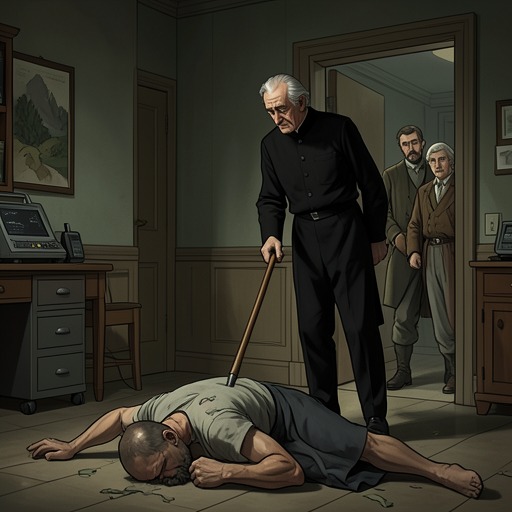
The decisive rejection comes after the lodgers have been driven away. Grete Samsa declares that the family cannot continue living in this manner and insists that they must get rid of the creature in Gregor’s room. Her argument depends partly on communication and humanity, but it also has an unmistakable economic consequence: she claims that the animal has driven out the tenants and threatens to take over the apartment, forcing the family onto the streets. Gregor’s presence is now interpreted through housing costs, lost rental income, and the fear of homelessness. The question is no longer how a dependent relative can be accommodated, but how an unproductive body can be removed from a financially pressured household.
After Gregor’s Death
The family’s response immediately after Gregor’s death makes the economic structure visible in retrospect. The charwoman announces that the problem has been settled, and Mr. Samsa initially reacts by saying she will be dismissed, as though even this final household service must be brought under control. The family then writes letters excusing its members from work and leaves the apartment together for the first time in months. Their excursion is not a return to the old order but the beginning of a new one: all three have jobs with good prospects, and they conclude that their most practical improvement would be to move into a smaller, cheaper, better-located flat.
The outing converts bereavement into planning. The family’s attention shifts from Gregor’s room to employment, housing, and Grete’s future. Mr. and Mrs. Samsa observe that Grete has grown into a healthy and attractive young woman, and they begin to imagine finding a suitable husband for her. The prospect of marriage extends the same logic that had governed Gregor’s life: a family member’s future is evaluated through the security, status, and economic promise that can be attached to it.
Economic dependence and debt therefore describe the book’s central exchange system. Gregor’s labor once sustains the family but binds him to an employer he despises; hidden savings preserve the household briefly but cannot replace wages; the family’s return to work restores its prospects while making Gregor increasingly superfluous. The transformation exposes a harsh premise: when familial belonging is organized around economic contribution, the loss of productive capacity can turn care into resentment and a person into an obstacle. Gregor’s death does not resolve the family’s financial vulnerability, but it permits the remaining members to imagine a smaller home, better employment, and a future no longer structured by the debt of maintaining him.